
How to Migrate an OJS AI Journal to a Modern Journal Management Platform
Artificial Intelligence and Big Data journals are growing rapidly in both the number of submissions and the complexity of their publishing workflows. Editors increasingly manage international authors, multiple reviewers, ethical compliance requirements, DOI registrations, indexing standards, and digital publishing expectations.
For many journals, particularly those that started with the Open Journal Systems (OJS) platform, there comes a stage when existing workflows become difficult to manage efficiently. As submission volumes increase and publishing requirements evolve, editors and publishers often begin exploring modern journal management platforms that offer greater automation, scalability, and user experience.
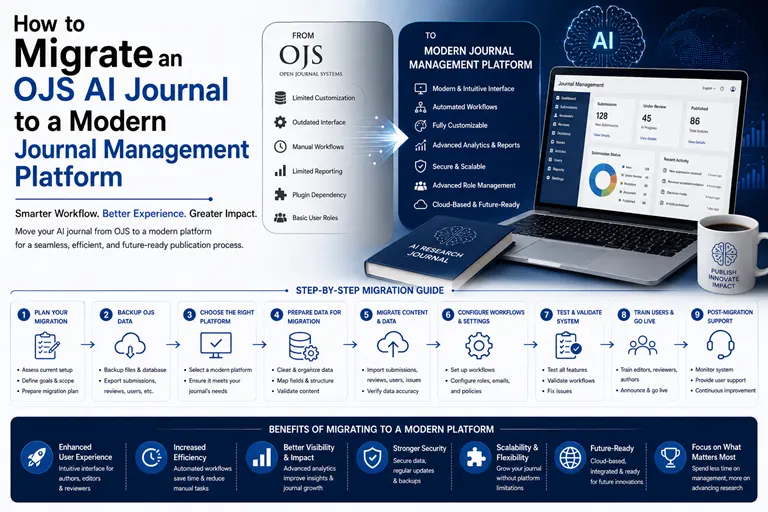
Migrating an AI journal from OJS to a modern journal management platform is not simply a technical exercise. It is a strategic decision that can significantly improve editorial efficiency, author satisfaction, and long-term journal growth.
The Journal of Artificial Intelligence and Big Data Disciplines (JAIBDD) recognizes the importance of modern publishing infrastructure and the role that efficient journal management systems play in supporting high-quality scholarly communication.
Why Many AI Journals Initially Choose OJS
Open Journal Systems has played an important role in democratizing scholarly publishing. Many new journals adopt OJS because it offers:
- Open-source availability
- Community support
- Basic editorial workflow management
- Article publishing capabilities
- Multi-user management
- Plugin ecosystem
For newly established journals, OJS can provide an effective starting point.
However, as journals grow, editorial teams often encounter operational challenges that require more advanced publishing infrastructure.
Common Challenges Faced by Growing OJS Journals
Many editors report difficulties such as:
- Complex administrative interfaces
- Time-consuming workflow management
- Dependence on technical support for customization
- Plugin compatibility issues
- Upgrade challenges
- Limited workflow automation
- Performance issues with large archives
- Complicated user experiences for authors and reviewers
Artificial Intelligence journals often receive technically sophisticated submissions involving datasets, supplementary materials, code repositories, and interdisciplinary collaborations. Managing these workflows efficiently can become increasingly difficult with older systems.
Signs That Your AI Journal May Need Migration
Your journal may benefit from migration if you experience the following challenges:
Increasing Submission Volume
Growing numbers of manuscripts can strain existing workflows.
Slow Editorial Processes
Manual processes often lead to publication delays.
Technical Maintenance Burden
Frequent updates and troubleshooting consume editorial resources.
Poor User Experience
Authors and reviewers increasingly expect intuitive digital platforms.
Limited Workflow Automation
Modern journals require greater efficiency and automation.
Expansion Plans
Journals planning indexing, international growth, and higher publication frequency often require more scalable infrastructure.
Why Modern Journal Management Platforms Matter
Modern publishing systems are designed to support the evolving needs of scholarly communication.
They typically offer:
- Streamlined manuscript submission
- Automated editorial workflows
- Better reviewer management
- Responsive website design
- Enhanced security
- Faster performance
- Integrated publishing tools
- Improved reporting and analytics
The objective is not merely replacing software but improving the entire publishing experience.
Benefits of Migrating an AI Journal to a Modern Platform
Improved Editorial Efficiency
Automation reduces repetitive administrative tasks and accelerates decision-making.
Better Author Experience
Simplified submission processes improve author satisfaction and increase repeat submissions.
Enhanced Reviewer Management
Automated invitations and reminders improve peer-review efficiency.
Improved Journal Visibility
Modern platforms are often better optimized for search engines and indexing readiness.
Scalable Infrastructure
Growing journals need systems that can accommodate increasing content and user demands.
Better Data Security
Modern platforms generally provide improved backup and security mechanisms.
Preparing for Journal Migration
A successful migration requires careful planning.
Editors should begin by assessing:
- Current website structure
- Published archives
- User accounts
- Editorial workflows
- DOI registrations
- Metadata quality
- Indexing requirements
- Existing integrations
Migration should always be approached as a structured project rather than an emergency technical task.
Step 1: Conduct a Comprehensive Journal Audit
Before migration, evaluate:
- Number of published articles
- Number of issues
- User accounts
- Editorial records
- Submission workflows
- Metadata completeness
- DOI assignments
- Supplemental files
A detailed audit reduces the risk of data loss and workflow disruptions.
Step 2: Define Migration Objectives
Common objectives include:
- Faster workflows
- Better user experience
- Improved website design
- Enhanced scalability
- Simplified administration
- Better indexing readiness
- Improved publishing analytics
Clearly defined objectives guide the entire migration process.
Step 3: Preserve Published Content and Metadata
One of the most critical aspects of migration is preserving:
- Articles
- Issues
- Author information
- Editorial records
- Metadata
- DOI links
- PDF files
- Supplementary materials
Proper metadata migration is essential for maintaining discoverability and indexing integrity.
Step 4: Preserve Search Engine Visibility
Journal migration should not negatively affect online visibility.
Editors should ensure:
- URL redirections
- Metadata preservation
- DOI continuity
- Sitemap updates
- Search engine indexing integrity
Proper planning minimizes traffic disruptions after migration.
Step 5: Test the New Platform Thoroughly
Testing should include:
- Submission workflows
- Reviewer workflows
- Editorial processes
- Email notifications
- Article publication
- Search functionality
- Mobile responsiveness
- User permissions
Testing reduces operational risks before launch.
Why Many Journals Are Moving Toward Modern Publishing Platforms
Scholarly publishing has changed significantly during the past decade.
Today's journals increasingly require:
- Better automation
- Faster workflows
- Improved accessibility
- Better mobile experiences
- Stronger security
- Easier administration
- Improved reporting
- Greater scalability
Modern journal management systems are designed to meet these evolving requirements.
ScholarJMS as a Modern Journal Management Solution
Modern journal management platforms such as ScholarJMS provide integrated solutions for:
- Journal website development
- Manuscript submission systems
- Editorial workflow management
- Peer review management
- Article publishing
- Author communication
- Editorial analytics
- Publishing automation
For many emerging journals, modern systems reduce administrative complexity and enable editorial teams to focus more on research quality and less on technical maintenance.
OJS Migration Requires Careful Technical Planning
Migration projects should address several technical considerations:
Content Migration
Transfer of archives and published issues.
User Migration
Migration of authors, reviewers, and editorial accounts.
Metadata Preservation
Maintaining article discoverability.
DOI Continuity
Ensuring persistent identifiers remain functional.
Workflow Configuration
Rebuilding editorial processes in the new system.
Indexing Readiness
Protecting search engine and database visibility.
The Importance of ISSN and Journal Infrastructure Planning
Many journals use migration as an opportunity to improve their overall publishing infrastructure.
This may include:
- Website redesign
- Publishing workflow improvements
- Metadata optimization
- Editorial policy updates
- Indexing preparation
- ISSN readiness support
Platforms such as OJSCloud assist journals with:
- Journal launch consulting
- OJS hosting
- OJS migration support
- ISSN consulting
- Publishing workflow guidance
- Technical publishing support
Why DOI Planning Matters During Migration
Digital Object Identifiers are critical components of modern scholarly publishing.
During migration, journals should ensure:
- Existing DOI links remain active
- Metadata remains synchronized
- Landing pages function correctly
- Citation continuity is preserved
Services such as GetDOI can assist journals with:
- Crossref DOI setup
- DOI workflow guidance
- Metadata registration support
- DOI management planning
Proper DOI management protects article discoverability and citation integrity.
Need Help Migrating Your Journal?
We can help with:
- OJS to ScholarJMS migration
- Journal website redevelopment
- Editorial workflow setup
- ISSN consulting
- Crossref DOI support
- Journal launch guidance
- Publishing technology consulting
WhatsApp: +91 82003 85143
Email: inquiry@ojscloud.com
Building Transparent and Future-Ready Publishing Ecosystems
Modern scholarly communication increasingly emphasizes:
- Research integrity
- Transparency
- Efficient workflows
- Better author experiences
- Trustworthy peer review
- Sustainable digital infrastructure
Platforms such as Scholar9 are helping journals and researchers build transparent research ecosystems and promote trust in scholarly publishing.
Best Practices for a Successful Migration
Editors should follow these recommendations:
- Plan migration carefully.
- Maintain backups.
- Preserve metadata.
- Test extensively.
- Communicate with stakeholders.
- Monitor search engine performance.
- Protect DOI continuity.
- Train editorial staff.
A structured approach significantly increases the likelihood of a successful migration.
Frequently Asked Questions (FAQs)
Why do journals migrate from OJS?
Many journals migrate to improve workflow efficiency, scalability, user experience, and administrative simplicity.
Will migration affect published articles?
A properly managed migration should preserve all articles, metadata, and DOI links.
Is OJS migration complicated?
Migration can be complex and requires careful planning, testing, and technical expertise.
Can DOI links be preserved after migration?
Yes. Existing DOI registrations can remain fully functional when migration is properly managed.
Can journals improve their publishing infrastructure during migration?
Yes. Migration often provides an excellent opportunity to redesign workflows and improve publishing systems.
Conclusion
As Artificial Intelligence and Big Data journals continue to grow, publishing infrastructure becomes increasingly important. Efficient editorial workflows, scalable technology, strong metadata management, and superior user experiences are essential for long-term journal success.
Migrating from OJS to a modern journal management platform is more than a software upgrade. It is a strategic investment in the future of the journal, its editorial team, and its scholarly community.
The Journal of Artificial Intelligence and Big Data Disciplines (JAIBDD) supports innovation not only in research but also in scholarly publishing practices. Journals seeking to modernize their publishing operations should carefully evaluate their technological needs and adopt systems that can support future growth.
Ready to Modernize Your Journal?
Whether you are planning a new journal website or migrating an existing OJS journal, we can help with:
✓ ScholarJMS journal management platform setup
✓ OJS migration services
✓ ISSN consulting and journal readiness support
✓ Crossref DOI setup and workflow guidance
✓ Editorial workflow optimization
✓ Journal launch consulting
WhatsApp: +91 82003 85143
Email: inquiry@ojscloud.com