
Agentic AI and Big Data Analytics: Emerging Research Opportunities for Scholars in 2026
Artificial Intelligence is entering a new era. While traditional AI systems have focused primarily on prediction, classification, and automation, the emergence of Agentic AI is transforming how intelligent systems perceive, reason, make decisions, and act autonomously.
At the same time, the unprecedented growth of big data is creating massive opportunities for advanced analytics, predictive intelligence, and autonomous decision-making systems. Together, Agentic AI and Big Data Analytics are shaping the next generation of digital transformation across industries.
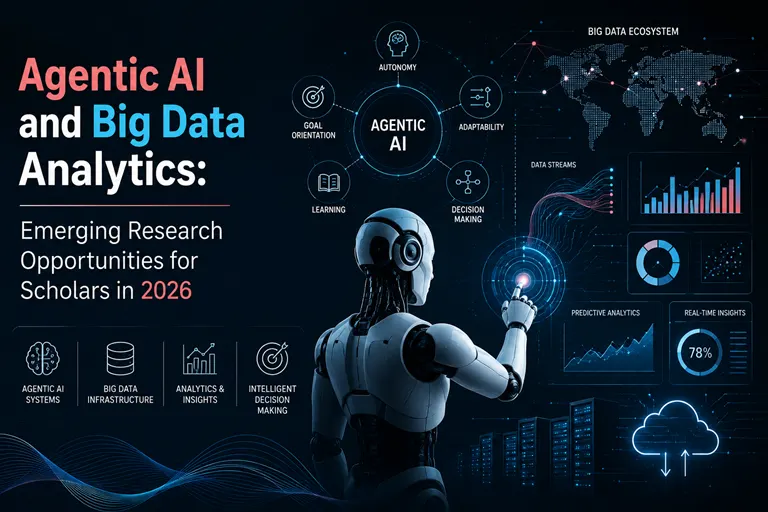
For researchers and scholars, 2026 presents an exciting landscape filled with interdisciplinary research opportunities. The convergence of intelligent autonomous agents and large-scale data ecosystems is opening new avenues for innovation in healthcare, finance, manufacturing, education, cybersecurity, smart cities, and scientific discovery.
The Journal of Artificial Intelligence and Big Data Disciplines (JAIBDD) encourages researchers to explore these emerging directions and contribute to the growing body of knowledge in this rapidly evolving domain.
Understanding Agentic AI
Agentic AI refers to intelligent systems capable of:
- Autonomous reasoning
- Goal-oriented planning
- Contextual decision-making
- Multi-step problem solving
- Adaptive learning
- Interacting with environments and other agents
Unlike traditional AI systems that execute predefined instructions, agentic systems can independently determine the actions required to achieve specific objectives.
Examples include:
- Autonomous research assistants
- AI-powered software development agents
- Intelligent financial advisors
- Medical diagnosis agents
- Autonomous industrial systems
- Scientific discovery agents
The development of large language models, reinforcement learning techniques, and multi-agent architectures has accelerated the adoption of agentic systems across various domains.
Why Big Data Analytics Is Essential for Agentic AI
Agentic AI depends heavily on large volumes of high-quality data. Big data analytics provides:
- Real-time information processing
- Pattern discovery
- Predictive capabilities
- Context awareness
- Personalized recommendations
- Continuous learning mechanisms
Without sophisticated data analytics, autonomous agents would struggle to make informed decisions.
The integration of:
- Structured data
- Unstructured data
- Sensor data
- Streaming data
- Knowledge graphs
- Multimodal datasets
is enabling the development of highly capable intelligent systems.
Major Research Trends in Agentic AI and Big Data Analytics
Autonomous Multi-Agent Systems
Multi-agent systems involve multiple intelligent entities collaborating to solve complex tasks.
Research opportunities include:
- Agent communication protocols
- Distributed reasoning systems
- Cooperative learning
- Collective intelligence
- Swarm intelligence
- Conflict resolution mechanisms
Applications include:
- Smart transportation
- Supply chain optimization
- Disaster management
- Autonomous robotics
- Smart manufacturing
Generative AI Agents
Generative AI has evolved from content creation to autonomous task execution.
Emerging research topics include:
- Self-improving AI agents
- Agent memory systems
- Long-term planning
- AI tool usage
- Autonomous coding systems
- Scientific research assistants
Researchers are increasingly studying how generative models can operate as independent decision-makers rather than simple content generators.
Explainable Agentic AI
As AI systems become more autonomous, transparency becomes increasingly important.
Research opportunities include:
- Explainable decision-making
- Trustworthy AI frameworks
- Human-AI collaboration
- Ethical reasoning systems
- Bias mitigation techniques
- Accountability mechanisms
Explainable AI is becoming a critical requirement in regulated industries such as healthcare, finance, and government.
Real-Time Big Data Analytics
Modern organizations generate enormous quantities of streaming data.
Research areas include:
- Edge analytics
- Real-time decision systems
- Event-driven architectures
- Streaming machine learning
- Distributed analytics platforms
- Autonomous monitoring systems
The demand for real-time intelligence continues to grow across industries.
Knowledge Graphs and Intelligent Reasoning
Knowledge graphs provide contextual understanding for autonomous systems.
Research opportunities include:
- Semantic reasoning
- Knowledge representation
- Context-aware intelligence
- Ontology engineering
- Dynamic knowledge updating
- Explainable reasoning systems
The integration of knowledge graphs with large language models is emerging as one of the most promising research directions.
Federated Learning and Privacy-Preserving Analytics
Data privacy regulations are driving research into decentralized AI systems.
Important research topics include:
- Federated learning architectures
- Secure multi-party computation
- Differential privacy
- Privacy-preserving analytics
- Distributed intelligence
- Confidential computing
These technologies are particularly relevant in healthcare, banking, and government applications.
Research Opportunities Across Industries
Healthcare and Precision Medicine
Applications include:
- Disease prediction
- Personalized treatment planning
- Clinical decision support
- Drug discovery
- Medical imaging analytics
- Intelligent patient monitoring systems
Big data and agentic AI have enormous potential to improve healthcare outcomes and operational efficiency.
Financial Services and Banking
Research areas include:
- Fraud detection
- Risk assessment
- Autonomous investment advisors
- Algorithmic trading
- Regulatory compliance systems
- Financial forecasting
The financial industry continues to be one of the largest adopters of advanced AI technologies.
Smart Cities and Urban Intelligence
Emerging applications include:
- Traffic optimization
- Energy management
- Public safety systems
- Urban planning
- Waste management
- Intelligent governance
Agentic AI can help cities become more sustainable and efficient.
Cybersecurity and Threat Intelligence
Research opportunities include:
- Autonomous threat detection
- AI-powered incident response
- Predictive cybersecurity analytics
- Malware intelligence
- Digital forensics
- Security automation
As cyber threats become more sophisticated, intelligent autonomous systems are becoming essential.
Manufacturing and Industry 5.0
Applications include:
- Predictive maintenance
- Autonomous quality control
- Supply chain intelligence
- Industrial robotics
- Smart factories
- Human-machine collaboration
Industry 5.0 places significant emphasis on intelligent, adaptive, and human-centric automation.
Emerging Research Methodologies
Researchers working in Agentic AI and Big Data Analytics are increasingly adopting methodologies such as:
- Deep learning
- Reinforcement learning
- Transfer learning
- Graph neural networks
- Causal inference
- Hybrid AI systems
- Digital twins
- Simulation environments
- Human-centered AI design
- Large-scale experimental frameworks
The combination of these methodologies creates new opportunities for interdisciplinary research.
Publication Opportunities for Scholars
The rapid growth of Agentic AI and Big Data Analytics has generated significant demand for high-quality scholarly publications.
Potential areas for publication include:
- AI architectures
- Intelligent agents
- Big data frameworks
- Machine learning methodologies
- AI ethics and governance
- Human-AI interaction
- Autonomous systems
- Enterprise AI applications
- Domain-specific intelligent systems
- Data engineering innovations
The Journal of Artificial Intelligence and Big Data Disciplines (JAIBDD) welcomes original research articles, review papers, case studies, and interdisciplinary contributions that advance the understanding and application of artificial intelligence and big data technologies.
The Importance of Transparent Research and Reproducibility
As AI research becomes increasingly complex, transparency and reproducibility are essential.
Researchers are encouraged to:
- Share datasets where appropriate
- Publish code repositories
- Provide detailed methodologies
- Promote open science practices
- Encourage reproducible research
Transparent research practices improve scientific integrity and accelerate innovation in artificial intelligence.
Future Directions Beyond 2026
Several emerging trends are expected to shape future research:
- Autonomous scientific discovery
- Self-improving AI agents
- Artificial General Intelligence foundations
- Neuro-symbolic reasoning
- Human-agent collaboration ecosystems
- Autonomous enterprise systems
- AI governance frameworks
- Responsible AI engineering
- Sustainable AI infrastructure
- Quantum-enhanced artificial intelligence
These developments will create substantial opportunities for scholars across disciplines.
Frequently Asked Questions (FAQs)
What is Agentic AI?
Agentic AI refers to autonomous artificial intelligence systems that can reason, plan, make decisions, and take actions independently to achieve specific goals.
Why is big data important for Agentic AI?
Big data provides the information and context necessary for intelligent agents to learn, reason, and make effective decisions.
Which industries are adopting Agentic AI rapidly?
Healthcare, banking, cybersecurity, manufacturing, education, logistics, and smart city management are among the leading adopters.
What research opportunities exist in this field?
Research opportunities include explainable AI, multi-agent systems, federated learning, autonomous reasoning, real-time analytics, and AI governance.
Can interdisciplinary researchers contribute to this field?
Yes. Researchers from computer science, engineering, healthcare, economics, management, and social sciences can contribute significantly to Agentic AI and Big Data research.
Conclusion
The convergence of Agentic AI and Big Data Analytics is redefining the future of intelligent systems. The transition from predictive models to autonomous, decision-making agents represents one of the most significant technological shifts of the decade.
For scholars, researchers, and practitioners, 2026 presents unprecedented opportunities to explore innovative methodologies, develop intelligent systems, and address real-world challenges through interdisciplinary research.
The Journal of Artificial Intelligence and Big Data Disciplines (JAIBDD) remains committed to publishing impactful research that advances the understanding of artificial intelligence, autonomous systems, and big data analytics. Researchers working in these emerging areas are encouraged to contribute their findings and participate in shaping the future of intelligent technologies.
Interested in publishing your research in Artificial Intelligence and Big Data Analytics? Explore the journal's aims and scope and consider submitting your latest research to JAIBDD.